3 Important Benefits of Music in Our Schools
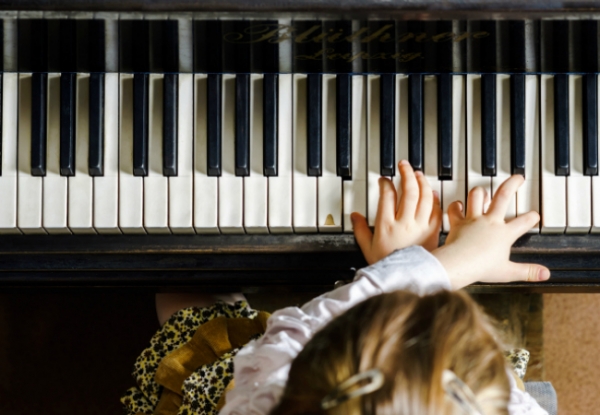
What do we hope for out of our education system? An education should make our children smarter, more confident, creative, and happy. It should enhance cognitive abilities and develop a well-rounded human being. So, why are so many school districts across the country scaling back or cutting out completely the one subject proven to do all those things?
A music education has numerous benefits that should not be ignored. Research shows that learning music helps children learn other subjects, such as math, and enhances skills that kids use in other areas as well. In my research of this topic, the following three benefits stood out most.
Language Development
According to professor of theory and music composition Anthony Brandt, even newborns have a basic understanding of music. He says it is the sounds of music, not the meaning of it,that babies first learn. Later, they can associate these sounds with what they mean. In his research paper titled Music and Early Language Acquisition, Brandt said that newborns can dissect parts of sounds like timbre, pitch, and rhythm, and therefore exposing the infant brain to music trains the brain for language comprehension.
The benefits do not end in infancy, however. Receiving a music education in the formative years helps develop reading comprehension skills as well. By applying the familiarity of melody to the way sentences are spoken aloud, there is a stronger likelihood of understanding the language more quickly.
Strikingly, Harvard researcher Gottfried Schlaug found a correlation between music training and language development in dyslexic children. He said, “[The findings] suggest that a music intervention that strengthens basic auditory music perception skills may also remediate some of their language deficits.”
Better Math Skills
Music improves spatial-temporal reasoning which is imperative for working through complex math problems. A UCLA study found that music education plays a major role in closing the achievement gap. They noted that disadvantaged students who performed with their school band or orchestra were more than twice as likely to perform at the highest levels of math as peers who did not receive music training. Furthermore, kids who learned fractions through a music based curriculum outperformed peers in traditional math classes.
Improved Brain Function
Laurel Trainor, director for the Institute for Music and the Mind at McMaster University says that even a year or two of music training leads to enhanced levels of memory and attention. Harvard University researcher Gottfried Schlaug also studied the cognitive effects of music training and found a correlation between early childhood music training and enhanced motor and auditory skills.
A study in 2013 led by Concordia University psychology professor Virginia Penhune and her team found that people who had music training early in life had stronger connections between motor regions and enhanced white matter in the corpus callosum, a bundle of nerve fibers that connect the left and right motor regions of the brain.
Finally, a 2014 study from Boston Children’s Hospital found a possible biological link between early music training and improved executive function in both children and adults. Executive functions are the higher-level cognitive processes that allow us to regulate our behavior, solve problems, and quickly process and retain information. Senior investigator Nadine Gaab, PhD, stated, “"Since executive functioning is a strong predictor of academic achievement, even more than IQ, we think our findings have strong educational implications. While many schools are cutting music programs and spending more and more time on test preparation, our findings suggest that musical training may actually help to set up children for a better academic future."